Ever wonder if that high-efficiency air filter you just bought is secretly killing your HVAC system?
You want clean air, but you don’t want to burn out your compressor or watch your energy bills skyrocket. That is where understanding the relationship between MERV ratings and pressure drop becomes a total game-changer.
Most people think a higher MERV rating is always better. But without balancing it against airflow resistance, you could be suffocating your AC. I’ve broken down exactly how to find that perfect sweet spot between pristine indoor air and peak system efficiency.
What Is a MERV Rating and Pressure Drop?
Selecting the right furnace filters requires a clear understanding of how air filtration impacts HVAC system performance. To optimize indoor air quality without damaging heating and cooling equipment, property owners must balance particle filtration with system airflow resistance.
Understanding MERV Ratings
MERV, or Minimum Efficiency Reporting Value, is the standard scale used to measure an air filter’s ability to trap airborne particles. Ranging from 1 to 16 for standard residential and commercial applications, the rating quantifies particulate matter filtration across various particle sizes, including dust, pollen, mold spores, and microscopic bacteria.
- Low MERV Ratings (1-4): Provide minimal filtration, trapping only large debris like lint and carpet fibers.
- Medium MERV Ratings (5-8): Ideal for standard residential settings, capturing dust mites, pet dander, and mold spores.
- High MERV Ratings (9-16): Deliver superior filter efficiency, capturing microparticles, tobacco smoke, and severe allergens.
As a premier MERV filter manufacturer, we engineer our pleated air filters to maximize particle capture while maintaining optimal system breathability.
What Is Pressure Drop in Plain Language?
In plain language, pressure drop is the measure of air flow restriction caused by the air filter. When the HVAC blower motor pushes air through the filtration medium, the filter creates resistance.
Think of it like breathing through a cloth mask: a thinner material allows easy airflow, while a thicker, denser material requires more effort to breathe through. In an HVAC system, this resistance is measured in inches of water column (in. w.c.). High pressure drop forces residential blowers to work harder, increasing energy consumption and accelerating equipment wear.
Initial vs. Pressure Drop
Understanding the life cycle of a pleated filter requires distinguishing between initial and final pressure drop:
| Metric | Definition | Impact on System |
|---|---|---|
| Initial Pressure Drop | The airflow resistance of a brand-new, clean air filter straight out of the box. | Establishes the baseline static pressure for the HVAC system. |
| Final Pressure Drop | The maximum allowable resistance before the filter becomes severely restricted and must be replaced. | Reaching this point triggers blower motor strain and reduces energy efficiency. |
As a filter accumulates dust, its dust-holding capacity is utilized. While the captured particles actually increase the filter’s efficiency over time, they simultaneously elevate the pressure drop curve. Monitoring this transition ensures you maintain the perfect balance between clean air and peak HVAC system performance.
Why Filter Pressure Drop Matters for Your HVAC System
Before referencing any MERV Ratings and pressure drop charts, you need to know why this metric controls your overall HVAC system performance. As a MERV filter manufacturer, we constantly see property owners buy the highest-rated filter without considering how that dense material affects their equipment.
Impact on Airflow and Energy Efficiency
Your AC and furnace rely on a steady, specific volume of air. When a filter has a high pressure drop, it creates a major air flow restriction.
- Weak Airflow: The system struggles to push conditioned air through your vents and into your rooms.
- Longer Cycles: Because cooling or heating the space takes longer, your equipment runs almost non-stop.
- Utility Spikes: Working harder for longer periods directly kills your energy efficiency, driving up your monthly power bills.
The Risks of Excessive Static Pressure
Ignoring airflow resistance leads to dangerously high HVAC static pressure. When a filter is too restrictive, your system essentially suffocates.
- Blower motor strain: The motor works overtime pulling against a wall of dense filter material, leading to premature burnout.
- Frozen AC coils: A severe lack of airflow stops the evaporator coil from properly absorbing heat, causing thick ice to form.
- Overheating: Without enough moving air to disperse heat, furnace heat exchangers can overheat and crack.
This static pressure spikes even faster as particulate matter builds up on the media. If your system constantly chokes and struggles to breathe, learning why your air filters get dirty so fast can help you manage particle buildup before it causes a catastrophic breakdown.
How Filter Material and Thickness Impact Performance
Not all filters block air the same way. The physical build of the filter changes the airflow dynamics entirely.
- Air filter thickness: A 4-inch filter usually has a significantly lower pressure drop than a standard 1-inch filter with the exact same MERV rating. The thicker filter has more surface area for air to pass through. Understanding exactly how to measure your air filter size ensures you can fit the deepest, least restrictive filter your system allows.
- Filter material: High-quality pleated air filters provide far greater dust holding capacity than cheap fiberglass options. They trap dangerous microparticles without immediately choking your residential blowers.
The MERV Ratings and Pressure Drop Chart Explained
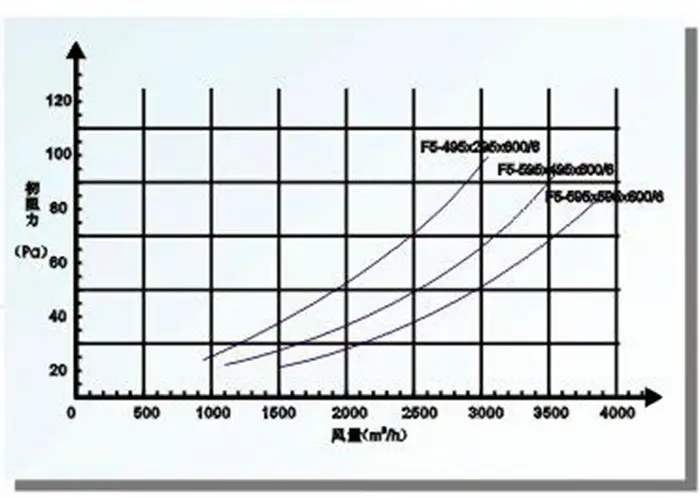
How to Read a MERV Pressure Drop Chart
Reading a pressure drop chart helps you understand how much an air filter will slow down your HVAC airflow. The chart typically plots airflow velocity—measured in feet per minute (FPM)—against resistance, measured in **inches of water column (in. w.c.)**. As airflow velocity increases, resistance goes up. To read it correctly, locate your system’s rated CFM (cubic feet per minute) on the chart, match it to the filter’s thickness, and find the corresponding initial pressure drop.
MERV Rating Breakdown and Airflow Resistance
Higher MERV ratings mean tighter pleats and denser media designed to capture smaller particulate matter. However, this tight weave naturally increases airflow resistance. As a MERV filter manufacturer, we engineer our pleated air filters to maximize dust holding capacity while keeping the initial pressure drop as low as possible. Balancing filter efficiency with HVAC system performance ensures you get clean air without choking your blower motor.
MERV Pressure Drop Reference Chart
| MERV Rating | Average Initial Pressure Drop (in. w.c.) | Airflow Resistance Level | Target Filtration Particles |
|---|---|---|---|
| MERV 8 | 0.12 – 0.15 | Low | Pollen, dust mites, lint |
| MERV 11 | 0.18 – 0.22 | Medium | Pet dander, mold spores, car smog |
| MERV 13 | 0.28 – 0.35 | Medium-High | Bacteria, smoke, and microscopic allergens |
Pressure Drop Comparison: MERV 8 vs. MERV 11 vs. MERV 13
Choosing between these three standard residential and commercial filters requires looking closely at the pressure drop curve:
- MERV 8: Offers the lowest restriction. It provides basic protection for residential blowers without causing noticeable static pressure spikes.
- MERV 11: The sweet spot for homes with pets. It increases resistance slightly but maintains good energy efficiency in most modern HVAC systems.
- MERV 13: Provides superior microparticle performance rating. It has the highest initial pressure drop, meaning your system requires a robust blower motor or a thicker filter design (like a 4-inch media filter) to prevent air flow restriction.
What Is an Acceptable Pressure Drop for Your AC?
Safe Static Pressure Guidelines for HVAC Systems
Every HVAC system has a maximum limit for total external static pressure, usually rated at 0.50 inches of water column (in. w.c.) for standard residential blowers. The air filter is only one part of this equation. For optimal HVAC system performance, the initial pressure drop of a clean pleated air filter should ideally stay between 0.10 and 0.20 in. w.c. Exceeding these parameters restricts airflow, starves the blower motor, and drastically reduces overall equipment efficiency.
Warning Signs of a Highly Restrictive Air Filter
When airflow resistance climbs too high due to an oversized MERV rating or a clogged filter, the system drops hints before a total breakdown occurs. Watch out for these clear warning signs:
- Weak Airflow: Weak or lukewarm air coming out of the supply vents.
- Whistling Noises: Unusual whistling or whistling sounds near the return air grille.
- Frequent Cycling: The system turns on and off rapidly (short-cycling) to protect itself from overheating.
- Frozen Coils: Ice buildup on the AC evaporator coils during summer.
- Spiking Energy Bills: The blower motor works twice as hard, causing a noticeable jump in monthly utility costs.
How to Measure Pressure Drop in Your System
Determining the exact airflow restriction requires measuring the static pressure on both sides of the filter using a digital manometer or a Magnehelic gauge.
- Drill Test Ports: Locate or drill two small test holes—one just before the air filter (upstream/return side) and one right after the filter (downstream/supply side).
- Insert Pressure Probes: Place the static pressure probes into the holes, ensuring they face into the airflow.
- Read the Differential: The manometer calculates the difference between the two readings. This final number represents the true pressure drop of your filter.
If you notice a major resistance issue during this test, it might be time to review our complete guide to MERV ratings to find a better balance between filtration efficiency and system health.
How to Choose the Right MERV Filter for Your Home
Balancing Filtration Efficiency and System Resistance
Choosing the perfect air filter comes down to a simple trade-off: capturing airborne particles without choking your HVAC system. As a MERV filter manufacturer, we design pleated air filters to maximize dust holding capacity while minimizing airflow resistance. High-efficiency filtration is useless if it creates too much air flow restriction and starves your system of air.
To achieve the best indoor air quality without sacrificing HVAC system performance, match your household needs to the right balance of filtration and resistance:
| Household Need | Recommended Filter | Balance Level |
|---|---|---|
| Basic protection, low resistance | MERV 8 | High Airflow / Standard Filtration |
| Pets, mild allergies, balanced airflow | MERV 11 | Balanced Airflow & Particle Capture |
| Severe allergies, asthma, and smoke relief | MERV 13 | Maximum Filtration / Managed Resistance |
HVAC System Compatibility and Motor Upgrades
Before sliding a high-efficiency filter into your slot, verify your system can handle the initial pressure drop. Older furnace filters and standard residential blowers are often rated for lower static pressure.
If your blower motor strains to pull air through a restrictive pleated filter, it can lead to short-cycling and premature equipment failure. For older HVAC systems, sticking to a lower MERV rating is safer unless you invest in a variable-speed blower motor upgrade to handle the increased HVAC static pressure. For a deeper dive into choosing the right rating for your specific setup, check out our MERV rating filter guide for home air quality.
When to Choose MERV 13 vs. Lower Ratings
Opt for a MERV 13 filter if your household requires superior particulate matter filtration to capture microscopic triggers like bacteria, smoke, and cough droplets. However, if your system cannot support the resistance of a MERV 13, opting for a standard pleated option is the smarter move. To see exactly how these ratings stack up side-by-side, read our comprehensive MERV 11 vs. MERV 13 air filter comparison.
- Choose MERV 13: If you have modern HVAC systems, severe respiratory issues, or live in areas prone to wildfire smoke.
- Choose MERV 8 or 11: If you have an older system, prioritize lower energy bills, or simply need standard dust and pet dander control.
Frequently Asked Questions About MERV and Pressure Drop
Do Higher MERV-Rated Filters Restrict Airflow Too Much?
Not necessarily, but they can if your system isn’t designed for them. Higher efficiency filters, like a tightly woven MERV 13 air filter, naturally create more airflow resistance because they catch smaller particles. As a MERV filter manufacturer, we design these with advanced pleated materials to maximize surface area, which keeps air flowing smoothly. However, if your HVAC system has a weak blower motor, an overly restrictive filter can choke your airflow.
Will a High-MERV Filter Raise My Energy Bill?
It can if you choose the wrong filter thickness or neglect routine maintenance. When airflow resistance increases, your blower motor works harder and draws more electricity. To enjoy superior particulate matter filtration without spiking your energy costs, look for deep pleated air filters that offer high dust holding capacity. This ensures your system maintains excellent energy efficiency while keeping your indoor air clean.
How Often Should I Replace a High-MERV Filter?
- Standard 1-inch filters: Every 60 to 90 days.
- Deep pleated filters (4 to 6 inches): Every 6 to 12 months.
- High-demand environments (pets, allergies): Inspect every 30 to 45 days.
As a rule of thumb, you should replace the filter before it reaches its final pressure drop. A heavily loaded filter skyrockets HVAC static pressure, putting severe blower motor strain on your equipment.
Can I Use a Thicker Filter to Lower Pressure Drop?
Yes, upgrading to a thicker pleated filter is one of the best ways to drop resistance. A 4-inch MERV 11 air filter actually has a lower initial pressure drop than a standard 1-inch MERV 11 filter. This happens because the deeper pleats vastly increase the total surface area, allowing more air to pass through easily while significantly upgrading your microparticle performance rating. Just ensure your filter rack or furnace slot has the physical space to accommodate the extra air filter thickness.