Ever wonder why a top-rated air filter can still leave your house dusty, or why a high-grade oil filter might actually strangle your engine?
It usually comes down to one massive misconception: confusing filter efficiency with filter effectiveness.
Most people look at a laboratory rating and assume it guarantees real-world results. It doesn’t. While filtration efficiency tells you what a filter can catch under perfect laboratory conditions, true filter effectiveness determines how it actually performs in the messy, unpredictable real world.
If you want to maximize indoor air quality, protect expensive equipment, and stop wasting money on the wrong ratings, you need to understand how these two forces clash—and how factors like effective filtration area (EFA) and airflow resistance change the game entirely.
Let’s break down exactly how to find the perfect balance for your system.
Understanding Filter Efficiency vs. Filter Effectiveness
Choosing the right filtration solution requires understanding two distinct performance metrics: filter efficiency and filter effectiveness. While often used interchangeably, they measure completely different aspects of filter performance.
Defining Filter Efficiency: Laboratory Capture Rates
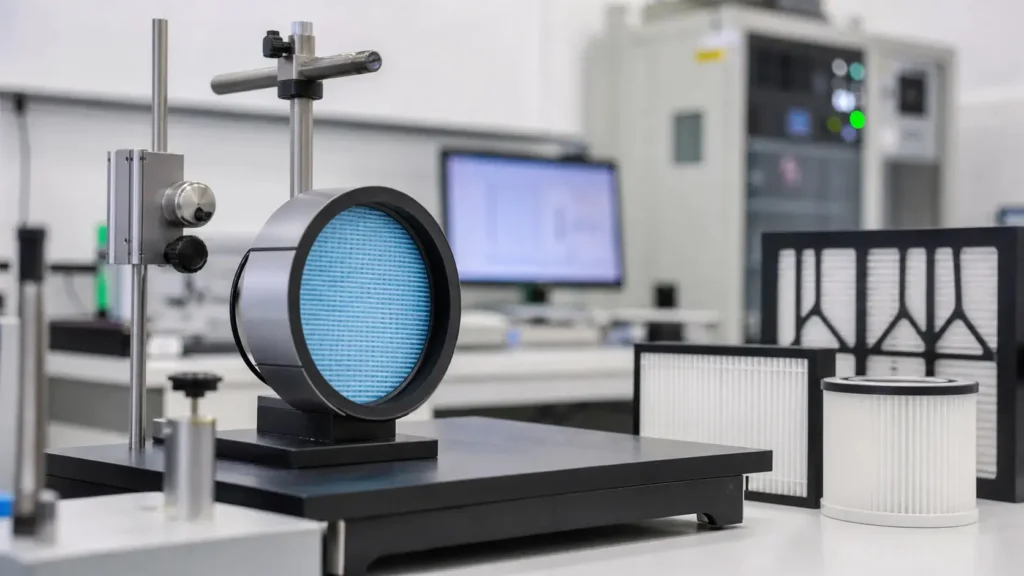
Filter efficiency represents a filter’s ability to capture particles of a specific size under controlled, standardized laboratory conditions. Expressed as a percentage, it measures how well the filter media stops contaminants during initial testing.
- Controlled Environment: Tested at fixed airflow rates, temperature, and humidity.
- Single-Pass Testing: Evaluates the percentage of particles trapped in a single pass through the media.
- Core Formula:
Efficiency (%) = (1 – Downstream Particle Concentration ÷ Upstream Particle Concentration) × 100
Key Takeaway: Efficiency indicates media quality and theoretical capture capability, not real-world performance over time.
Defining Filter Effectiveness: Real-World Performance Impact
Filter effectiveness measures how well a filter reduces target contaminants within an active, operating system over time. It accounts for real-world variables that laboratory tests ignore.
- System Integration: Factor in duct leakage, bypass airflow, and air velocity fluctuations.
- Accumulated Loading: Evaluates performance changes as dust loading increases and differential pressure.
- Overall Cleanliness: Reflects actual improvement in indoor air quality (IAQ) or fluid purity in your facility.
Filter Efficiency vs. Effectiveness: Key Differences Explained
High lab efficiency does not guarantee high operational effectiveness. If air bypasses an improperly fitted high-efficiency filter, overall system effectiveness drops significantly.
| Feature | Filter Efficiency | Filter Effectiveness |
|---|---|---|
| Measurement Focus | Particle capture percentage | Total contaminant reduction in space/fluid |
| Test Environment | Standardized laboratory | Operational field conditions |
| Primary Variable | Filter media pore size and structure | System design, seals, airflow, and maintenance |
| Key Metric | MERV, HEPA, Beta Ratio | Delivered Air Quality, Clean Air Delivery Rate (CADR) |
| Impacted By | Fiber composition, electrostatic charge | Bypass leakage, pressure drop, loading rate |
As a direct filter manufacturer, we engineer filter media that balances high capture efficiency with low airflow resistance to maximize real-world effectiveness in your systems.
How Filter Efficiency Is Measured and Rated
Air Filtration Standards: MERV, MPR, FPR, and HEPA
Measuring how well a filter performs starts with standardized rating systems. In the air filtration industry, different standards help us quantify capture capability based on particle size:
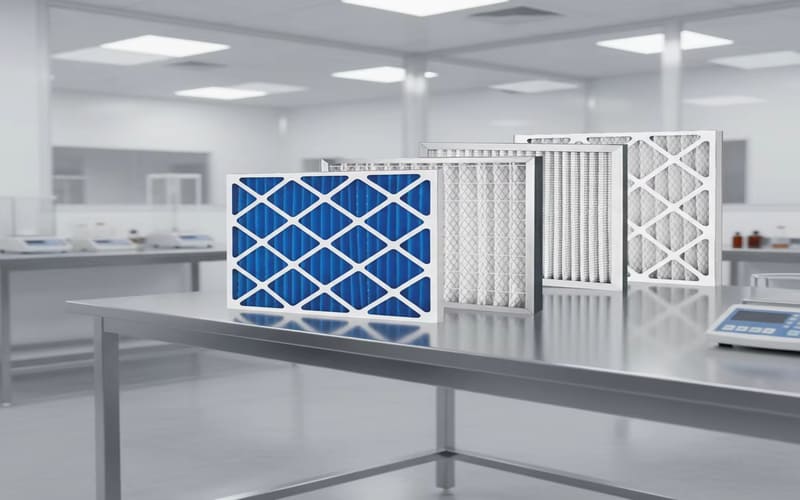
- MERV (Minimum Efficiency Reporting Value): The global standard scale ranging from 1 to 16 (and up to MERV 17-20 for specialized applications). It measures a filter’s ability to capture particles between 0.3 and 10 microns. For comprehensive home and commercial performance, understanding different types of air filters and their ratings helps align MERV levels with specific air quality needs.
- MPR (Microparticle Performance Rating): A brand rating scale (ranging from 300 to 2800) focusing primarily on microscopic particles between 0.3 and 1.0 microns, such as smoke and bacteria.
- FPR (Filter Performance Rating): A 1 to 10 scale rating system designed to simplify consumer choices based on overall contaminant removal ability.
- HEPA (High-Efficiency Particulate Air): A strict performance standard requiring a filter to trap at least 99.97% of airborne particles down to 0.3 microns.
Liquid and Oil Filter Ratings: Nominal, Absolute, and Beta Ratings
Liquid and oil filtration rely on distinct metrics to measure single-pass efficiency and structural retention capacity:
| Rating Type | Definition | Efficiency Level |
|---|---|---|
| Nominal Rating | Indicates an arbitrary micrometer value based on a percentage of particle retention (e.g., 85% of 10-micron particles). | Approx. 50%–85% |
| Absolute Rating | Represents the size of the largest hard spherical particle that will pass through the filter under specific lab conditions. | 99.9% or higher |
| Beta Rating ($\beta$) | The ratio of particles larger than a given size found upstream versus downstream of the filter media. | Calculated per particle size |
Formulas and Calculations for Filtration Efficiency
To calculate exact single-pass filter efficiency in a lab environment, we compare particle counts before and after the filter media using the upstream and downstream concentration:
Efficiency (%) = ((C_upstream – C_downstream) / C_upstream) × 100
Where C_upstream is the particle count entering the filter, and C_downstream is the particle count exiting it.
For liquid systems, the Beta Ratio (βx) for a specific particle size (x) is calculated as:
βx = Particles upstream (> x microns) / Particles downstream (> x microns)
To convert a Beta Ratio directly into a percentage efficiency value, use the following formula:
Efficiency (%) = (1 – 1 / βx) × 100
For example, a Beta Ratio of 1000 at 5 microns means the filter traps 99.9% of all 5-micron contaminants entering the stream.
The Role of Effective Filtration Area (EFA) in Performance
What Is Effective Filtration Area (EFA)?
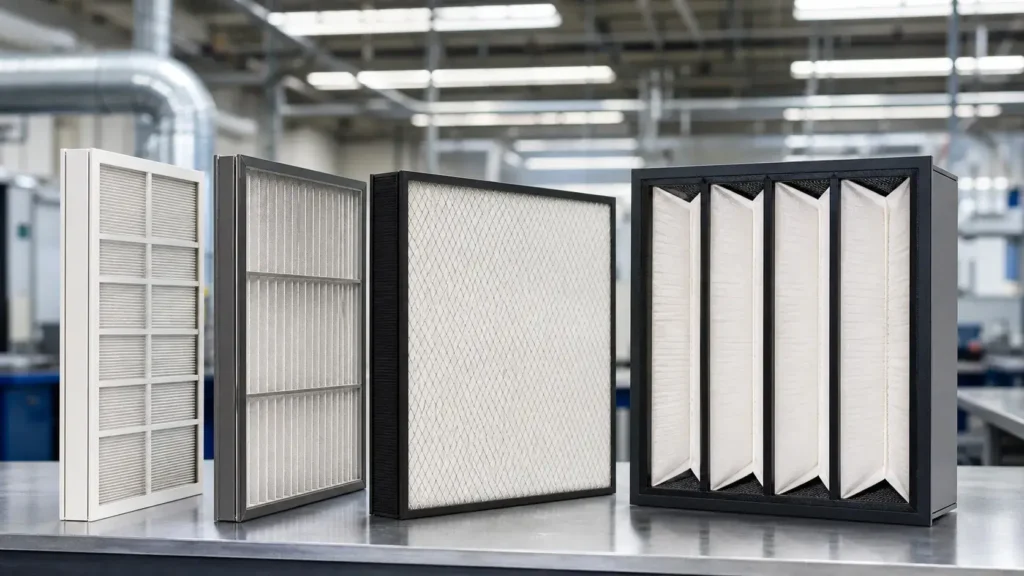
As an air filter manufacturer, we define Effective Filtration Area (EFA) as the total usable surface area of the filter media actively capturing particles during operation. EFA excludes structural components like glued edges, frame borders, and support meshes. While two filters might share identical outer frame dimensions, their EFA can vary wildly based on pleat depth, pleat count, and media configuration.
Maximizing EFA ensures media exposure remains high, which lowers face velocity across the filter material. This structural design factor directly determines how long a filter performs before reaching its maximum allowable pressure drop.
EFA Comparison Across Filter Designs
| Filter Design Type | Pleat Depth / Structure | EFA Relative Yield | Typical Performance Impact |
|---|---|---|---|
| Flat Panel | 1 inch / Flat media | Low | High initial resistance, quick clogging |
| Standard Pleated | 2 inch / Uniform pleats | Medium | Balanced airflow and standard dust collection capacity |
| Deep-Pleated Mini-Pleat | 4–12-inch / High-density folds | High | Low air flow resistance, extended service life target |
How Surface Area Impacts Airflow and Dust-Holding Capacity
Expanding the surface area of a filter alters how air or liquid moves through the media. A larger EFA yields two distinct operational advantages:
- Higher Dust-Holding Capacity: Spreading incoming debris across a larger total surface area prevents rapid media clogging. This allows the filter to trap a higher volume of contaminant load before requiring replacement.
- Reduced Airflow Resistance: A larger EFA distributes volume, reducing face velocity across the media. Lower velocity minimizes overall pressure drop, allowing furnace filters for airflow and indoor air quality to maintain peak system throughput without strain on HVAC blowers.
| Smaller EFA | Larger EFA (Pleated) |
|---|---|
| Airflow → through media | Airflow → through pleated media |
| Smaller Effective Filtration Area (EFA) | Larger Effective Filtration Area (EFA) |
| High air velocity through media | Low air velocity through the media |
| Rapid clogging | Longer service life |
Calculating EFA for Air and Liquid Applications
Determining EFA requires precise measurement of the active media boundary, excluding sealed or covered edges.
For Pleated Air Filters: EFA = 2 × Pleat Height × Pleat Depth × Number of Pleats
For Liquid and Oil Filter Cartridges: EFA = π × Average Diameter × Active Cylinder Height
For pleated oil filter media and specialized liquid filtration applications, engineers adjust these baseline formulas to account for core perforations, outer mesh wraps, and structural pleat spacing. Calculating EFA accurately allows equipment operators to size filters properly, preventing premature clogging and maintaining optimal particle size capture.
Key Factors Influencing Filtration Efficiency and Effectiveness
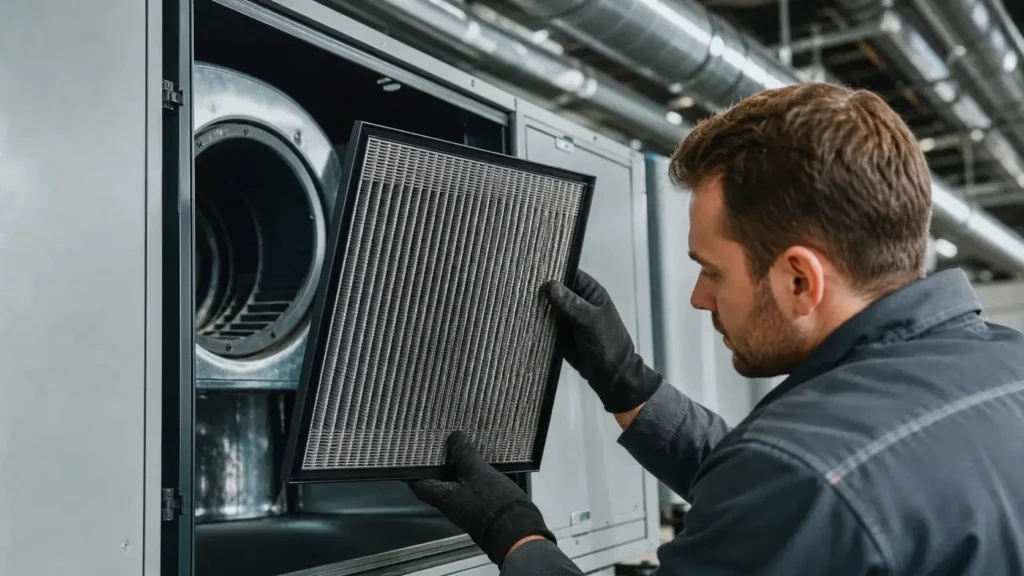
Understanding filter efficiency versus filter effectiveness requires a close look at the operational variables that impact media performance in real-time settings. While lab tests measure pristine capture capability, actual contaminant removal depends heavily on environmental and structural factors.
Particle Size, Distribution, and Contaminant Load
The size and concentration of airborne or liquid particles dictate how quickly a filter media captures debris and how fast it reaches its holding capacity.
- Particle Size: Sub-micron particles (0.3 microns and smaller) rely on diffusion to get trapped, while larger particles (>10 microns) rely on impaction and interception.
- Particle Distribution: A wide range of particle sizes creates a dense filter cake, which can alter media porosity faster than uniform dust loads.
- Contaminant Load: Heavy particulate concentration accelerates filter loading, causing a faster rise in resistance across the system.
Airflow Velocity and Differential Pressure
Airflow velocity directly affects how long particles interact with the filter media, while differential pressure tracks system resistance.
| Operational Factor | Impact on Efficiency | Impact on Effectiveness |
|---|---|---|
| Higher Airflow Velocity | Decreases the capture of fine particles due to higher kinetic energy. | Reduces residence time, lowering overall contaminant removal. |
| Increased Differential Pressure | Signals full dust-holding capacity; may cause particle blow-through. | Restricts airflow, leading to high system energy consumption and poor indoor air quality. |
When high particulate buildup goes unaddressed, severe system strain occurs. Monitoring these metrics prevents issues like a clogged HVAC filter from degrading overall performance.
Filter Media Composition and Structural Design
The physical construction of the filter media dictates its structural integrity, dust collection capacity, and service life target under continuous operation.
- Fiber Material: Synthetic polymer fibers offer moisture resistance, whereas glass microfiber media excels in ultra-fine particulate capture.
- Pleat Geometry: Uniform pleat spacing maximizes the effective filtration area, lowering initial pressure drop and extending operational lifespan.
- Structural Frame: Rigid frames prevent media collapse under heavy pressure drop, maintaining a tight seal to stop bypass airflow.
How Filter Efficiency Impacts HVAC and Equipment Performance
As an air filter manufacturer, we see firsthand how choosing the right media directly influences system longevity, power draw, and overall indoor comfort. The balance between filter efficiency versus filter effectiveness comes down to how well a filter cleans the air without choking your equipment. High laboratory capture rates mean very little if your unit works too hard just to pull air through the system.
Airflow Resistance and Energy Consumption
Every filter creates a barrier in your ductwork. As you increase particle capture rates, you also increase initial airflow resistance—commonly measured as pressure drop.
- Higher Resistance, Higher Bills: When pressure drop spikes, your blower motor works harder to maintain necessary airflow, leading to a noticeable bump in energy consumption.
- Reduced Air Volume: Restricted air volume forces HVAC systems to run longer cycles to reach set temperatures, causing unnecessary wear and tear.
- Energy Balance: Finding the sweet spot between a high MERV rating and low static pressure is essential to keeping operating costs down while keeping air clean.
Balancing Indoor Air Quality (IAQ) and System Workload
Achieving healthy indoor air requires a delicate balance between contaminant removal and mechanical workload. Capturing fine dust, pollen, and microscopic particles protects both human health and sensitive equipment components.
| IAQ Focus | System Impact | Management Strategy |
|---|---|---|
| High Particle Capture | Increased static pressure on the blower | Use pleated filters to expand surface area |
| Dust & Debris Control | Keeps coils clean, maintaining thermal transfer | Schedule routine changeouts to prevent heavy loading |
| Air Turnover Rate | Reduced total air volume if resistance is too high | Match filter ratings to specific fan capabilities |
If you ever need to inspect your system or run tests temporarily, avoid operating your unit completely bare. Knowing can you run an air conditioner without a filter helps prevent severe long-term damage to exposed coils and motors.
The Risks and Costs of Over-Filtering
Installing a filter with an efficiency rating beyond what your equipment was designed to handle leads to severe operational bottlenecks. Over-filtering restricts system breathability, creating major performance risks:
- Frozen Evaporator Coils: Inadequate air flow prevents heat exchange, causing moisture on the cooling coils to freeze solid.
- Blower Motor Burnout: Overworked fans run continuously under high stress, leading to premature motor failure and costly service calls.
- Excessive Filter Loading: Ultra-dense media traps surface dust rapidly, causing rapid pressure spikes and shortening total service life.
- System Overheating: In heating modes, choked airflow trips high-limit switches, forcing frequent system shutdowns.
When a filter turns dark unexpectedly fast, understanding why your air filter is black can help you identify whether the issue stems from soot, mold, or severe over-loading before it damages your equipment. Matching the exact filter media to your system’s design specs avoids these hidden operational costs while delivering clean, healthy air efficiently.
How to Choose the Right Filter for Maximum Effectiveness
Balancing filter efficiency versus filter effectiveness comes down to real-world performance in your specific setup. A filter with high lab efficiency can still fail in practice if it chokes your equipment or lets bypassed air slip through. Here is how we recommend picking the best solution for your system.
Assessing Application Requirements and Target Pollutants
First, identify what you need to capture and where your equipment operates.
- Particle Size: Heavy dust and pollen require standard pleated media, while smoke, bacteria, and fine particulates require high MERV ratings or HEPA filtration.
- Gas & Odor Control: For chemical vapors or volatile organic compounds (VOCs), mechanical media alone is not enough; integrating specialized media like carbon filters in air purification systems is necessary for true contaminant removal.
- Environment Risks: High-humidity settings require moisture-resistant media to protect system health.
Matching Efficiency Ratings to System Capabilities
Never select a filter based on its capture rate alone. You must match the media to your blower’s airflow capacity to avoid severe pressure drops.
| Target Application | Recommended Rating | Primary Focus | Airflow Impact |
|---|---|---|---|
| Basic Commercial | MERV 8–11 | Bulk dust & lint removal | Minimal resistance |
| Advanced Commercial / IAQ | MERV 13–16 | Bacteria & fine particulates | Moderate resistance |
| Industrial Blower / AHU | Heavy-Duty Media | Protecting air handling unit filters | Engineered for high static pressure |
Establishing Maintenance and Filter Replacement Schedules
Even the most efficient filter loses its effectiveness once it reaches maximum dust-holding capacity.
- Monitor Pressure Drop: Track differential pressure across the bank rather than relying solely on a fixed calendar date.
- Set Clear Service Life Targets: Replace media before airflow resistance overworks your HVAC fans and spikes energy usage.
- Inspect Seals & Frames: Ensure tight structural seals to prevent dirty air from bypassing the media entirely.