Understanding Air Filter Resistance and Efficiency
Selecting the ideal HVAC filters requires balancing particle removal with unimpeded system airflow. Every filter media creates some level of airflow restriction, making it essential to understand how resistance and efficiency interact within an HVAC system.
What Is Air Filter Resistance (Pressure Drop)?
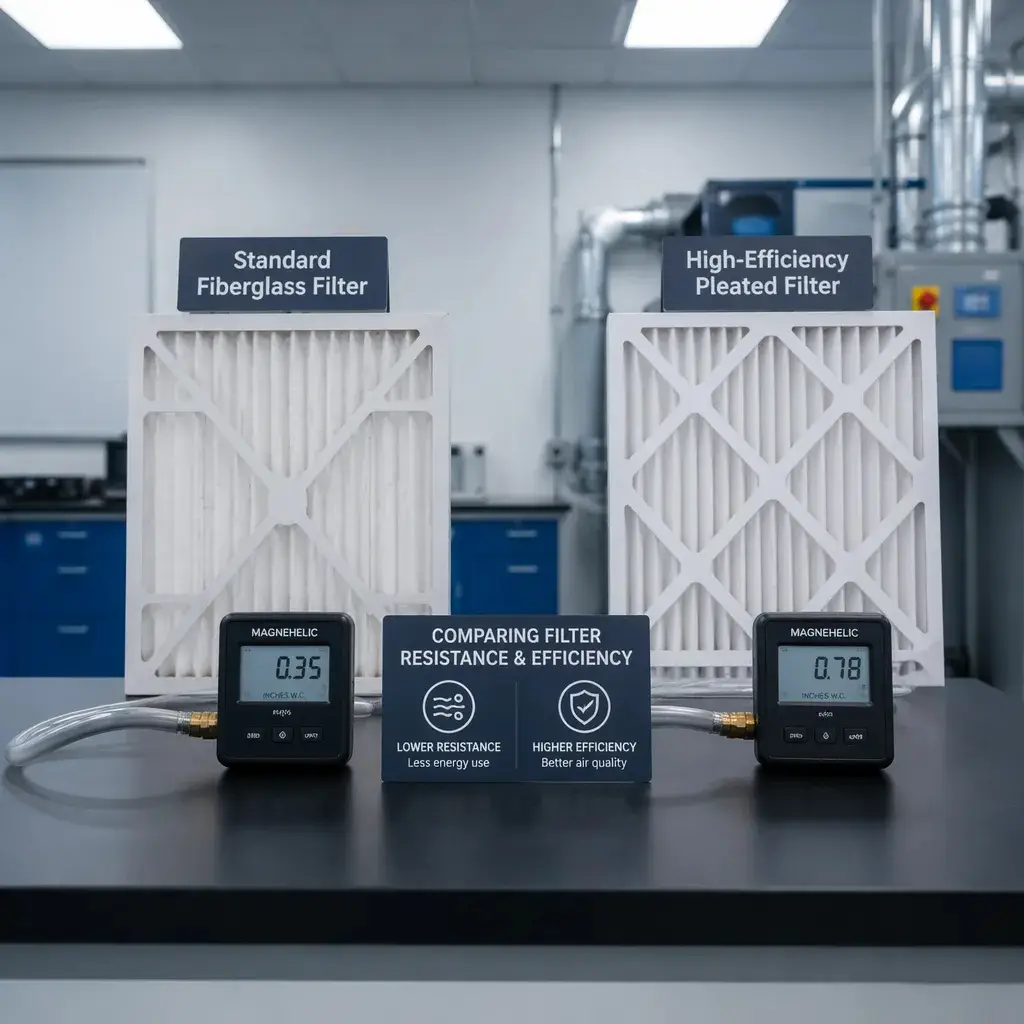
Air filter resistance—commonly referred to as pressure drop—measures the resistance to airflow as air passes through the filter media. Measured in inches of water column (in. w.g.), pressure drop directly influences the static pressure within your ductwork. Higher resistance forces the blower motor to work harder to maintain the target air velocity, impacting energy consumption and overall system lifespan.
What Is Filtration Efficiency?
Filtration efficiency measures a filter’s ability to trap airborne contaminants of varying sizes. Expressed through standardized benchmarks like the MERV rating, efficiency indicates the percentage of particle capture across specific micron ranges—from large dust and pollen to fine smoke and bacteria. Denser filter media achieves higher efficiency by trapping microscopic pollutants more effectively.
The Core Relationship Between Airflow Resistance and Efficiency
Efficiency and resistance share a direct operational relationship: as media density increases to capture smaller particles, air restriction naturally rises. However, proper filter engineering can optimize this balance.
- Media Density: Tighter fiber weaves improve particle capture but elevate initial pressure drop.
- Surface Area: Increasing the pleat count expands total media surface area, lowering air restriction while maintaining high efficiency.
- Electrostatic Charge: Specialized fibers enhance microscopic particle capture without requiring denser physical barriers.
| Metric | Primary Focus | Performance Goal |
|---|---|---|
| Pressure Drop | System airflow & static pressure | Minimize airflow restriction to protect HVAC hardware |
| Filtration Efficiency | Indoor air quality & particle capture | Maximize contaminant removal for healthier indoor environments |
Air Filter Rating Systems Compared (MERV, MPR, FPR)
Navigating air filter ratings can get confusing fast because different brands use different measurement scales. As an HVAC filter manufacturer, we design filter media to meet exact standard metrics, helping you balance filtration efficiency and airflow resistance without damaging your equipment.
Understanding MERV Ratings
Minimum Efficiency Reporting Value (MERV) is the independent standard created by ASHRAE. It evaluates how effectively a filter captures particles sized between 0.3 and 10 microns on a scale from MERV 1 to 16 for standard residential and commercial systems.
- Higher ratings mean finer particle capture, trapping small contaminants like smoke and bacteria.
- Higher resistance often accompanies higher ratings if the filter lacks sufficient surface area or pleat count to maintain proper airflow velocity.
For a deeper dive into these standard benchmarks, explore our complete guide to MERV ratings.
FPR and MPR Rating Systems Explained
While MERV is the national standard, leading retail brands developed proprietary rating systems to highlight specific performance traits:
- MPR (Microparticle Performance Rating): Created by 3M (Filtrete), this scale ranges from 300 to 2800. It focuses specifically on a filter’s ability to capture tiny microparticles between 0.3 and 1.0 microns, such as smog, smoke, and cough droplets.
- FPR (Filter Performance Rating): Developed by Home Depot for products sold in their retail stores, FPR uses a simple 1 to 10 scale (or categorized from Good to Premium). It evaluates particle capture, dust holding capacity, and resistance to airflow.
Comparing MERV vs. MPR vs. FPR Ratings
Different rating scales evaluate similar particle capture capabilities. Knowing how these systems align helps you select the right pleated air filter to protect both your indoor air quality and your system’s blower motor from excessive static pressure.
Read our comprehensive MERV vs. FPR vs. MPR air filter ratings guide for an in-depth breakdown of these metrics.
| MERV Rating | MPR Rating (3M) | FPR Rating (Home Depot) | Primary Particle Capture Targets |
|---|---|---|---|
| MERV 1–4 | < 300 | N/A | Large dust, lint, carpet fibers |
| MERV 5–8 | 300–600 | 4–5 (Good) | Pollen, dust mites, mold spores |
| MERV 9–12 | 1000–1200 | 6–8 (Better / Best) | Fine dust, pet dander, auto emissions |
| MERV 13–16 | 1500–2800 | 9–10 (Premium) | Bacteria, smoke, carrier viruses |
Comparing Filters for Resistance and Efficiency Across Rating Levels
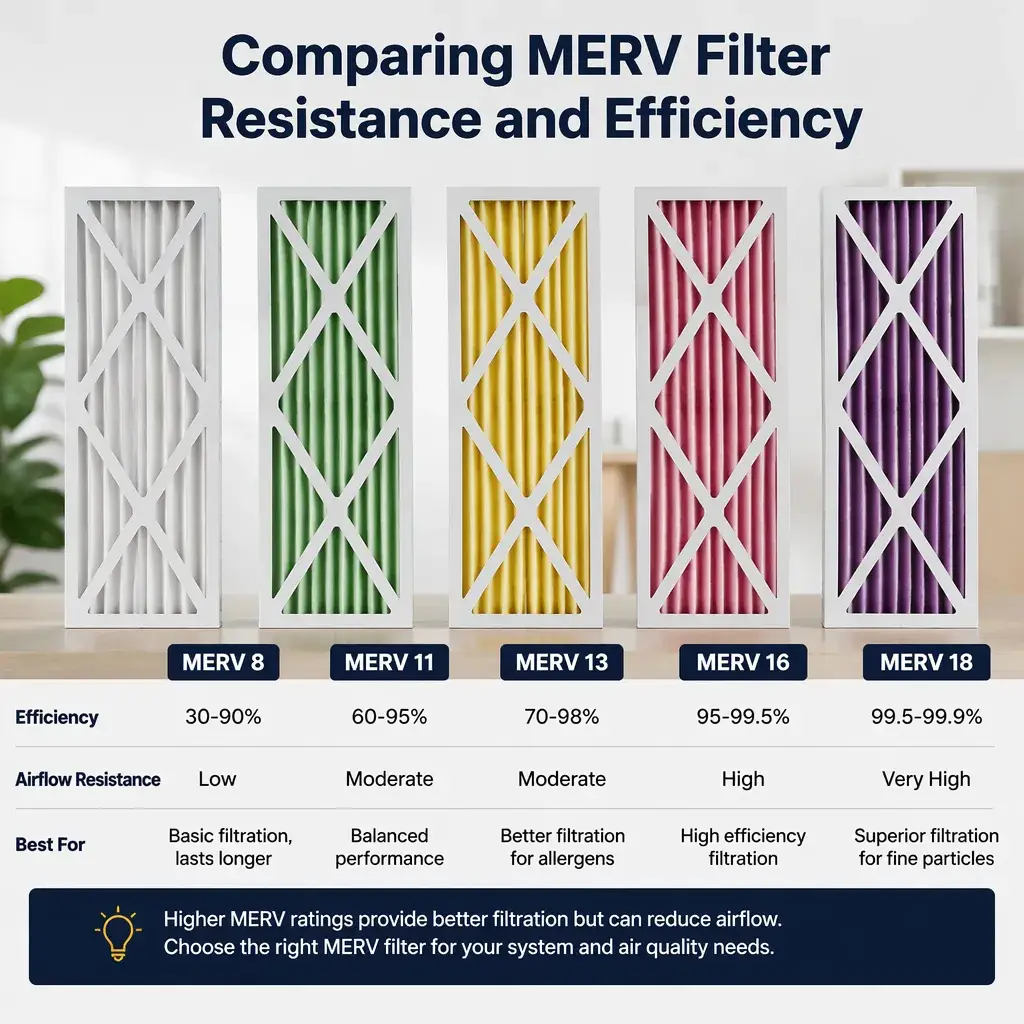
Finding the ideal balance between filtration efficiency and airflow resistance depends heavily on the filter rating. As an HVAC filter manufacturer, we engineer our filter media to optimize particle capture while keeping pressure drop within safe operational limits.
| Rating Level | MERV Range | Particle Capture | Air Resistance (Pressure Drop) | Primary Application |
|---|---|---|---|---|
| Low Efficiency | MERV 1–4 | Large debris, lint, dust | Very Low | Basic equipment protection |
| Medium Efficiency | MERV 5–8 | Mold, dust mites, pollen | Moderate | Standard residential HVAC |
| High Efficiency | MERV 9–13 | Fine dust, pet dander, bacteria | Moderate to High | Allergy relief & high air quality |
| HEPA / Specialty | HEPA / MERV 17+ | Microscopic particles, viruses | Very High | Cleanrooms & hospital settings |
Low-Efficiency Filters (MERV 1–4)
- Airflow Impact: Delivers the lowest static pressure drop across all rating categories, maintaining maximum airflow velocity.
- Filtration Capability: Traps large dust particles, carpet fibers, and lint.
- Filter Media Construction: Typically uses low-density fiberglass or flat synthetic panels with low pleat counts.
- Core Function: Protects the furnace blower motor from major debris buildup, but offers minimal improvement to indoor air quality.
Medium-Efficiency Filters (MERV 5–8)
- Airflow Impact: Maintains a balanced airflow resistance that standard residential HVAC systems handle easily.
- Filtration Capability: Traps common household allergens, mold spores, and pollen.
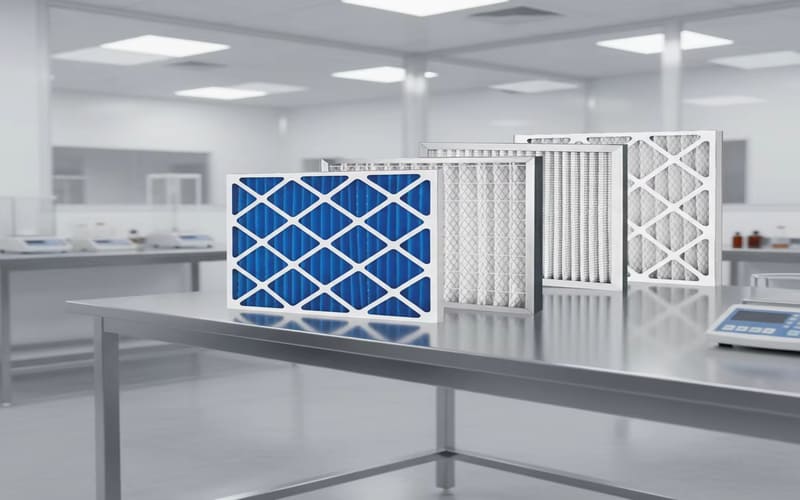
- Filter Media Construction: Utilizes a pleated air filter design that expands total surface area, preventing premature air restriction.
- Core Function: Ideal for everyday residential use; check our MERV 8 vs. MERV 11 air filters guide to evaluate which resistance level fits your system setup.
High-Efficiency Filters (MERV 9–13)
- Airflow Impact: Introduces moderate to high resistance, requiring adequate system blower capacity to manage increased static pressure.
- Filtration Capability: Captures fine particle pollution, pet dander, smoke, and airborne bacteria.
- Filter Media Construction: Uses dense synthetic or electrostatically charged fibers designed to capture smaller particles without choking airflow.
- Core Function: Delivers superior air quality for homes with allergy sufferers or pets; review when to upgrade from MERV 8 to MERV 13 filters to ensure your fan motor can handle the added resistance.
HEPA and High-Resistance Specialty Filters
- Airflow Impact: Causes significant air restriction and high pressure drop that typical residential ductwork and blower motors cannot handle without retrofits.
- Filtration Capability: Traps at least 99.97% of particles down to 0.3 microns.
- Filter Media Construction: Made from densely packed, ultra-fine glass fibers.
- Core Function: Essential for medical facilities, isolation rooms, and standalone air purifiers where particle capture takes priority over system airflow efficiency.
Impact of Filter Resistance on HVAC Systems
As an HVAC filter manufacturer, we consistently emphasize that comparing filters for resistance and efficiency is about protecting your mechanical assets as much as improving indoor air quality. When an air filter introduces excessive air restriction, it changes how your whole system operates.
How High Resistance Affects Airflow and Blower Motors
High resistance creates excessive static pressure inside ductwork, forcing the equipment to push air against a heavy barrier.
- Blower Motor Strain: Variable-speed blower motors increase RPMs to compensate for restricted airflow, causing higher operational heat and premature motor burnout. Standard motors simply deliver less air.
- Reduced Airflow Velocity: Lower airflow velocity creates hot and cold spots across living spaces, making thermal comfort harder to maintain.
- Air Bypass Issues: Excessive pressure drop forces air around the filter frame edges, pulling unconditioned, dirty air straight into the system.
Energy Consumption and Pressure Drop Considerations
A filter’s pressure drop directly influences how long system components must run to hit thermostat setpoints. Higher initial resistance causes systems to draw more kilowatt-hours during every cycle.
| Resistance Level | Initial Pressure Drop | Impact on Blower Motor | System Energy Draw |
|---|---|---|---|
| Low Resistance | Minor (0.05 – 0.15 in. w.g.) | Minimal effort required | Standard Baseline |
| Medium Resistance | Moderate (0.15 – 0.28 in. w.g.) | Steady, designed operating load | Slight Increase (+3–5%) |
| High Resistance | Heavy (0.30+ in. w.g.) | Maximum continuous load / overheating risk | Significant Spike (+10–15%) |
As dust accumulates on dense filter media, resistance rises exponentially, forcing furnace filters to drag down system performance even faster.
Preventing HVAC System Damage from Airflow Restriction
You do not need to sacrifice filtration efficiency to keep your equipment safe. Managing resistance requires smart filter design and timely maintenance:
- Maximize Surface Area: Opt for filters with a higher pleat count or deeper media beds, which lower resistance without dropping efficiency ratings.
- Monitor Performance: Learn the critical signs your HVAC filter is clogged to replace filters before restricted airflow causes evaporator coils to freeze.
- Check Equipment Ratings: Always verify your air handler’s maximum allowable static pressure before upgrading to high-density pleated media.
How to Select the Right Filter for Resistance and Efficiency
Selecting the perfect furnace filters requires balancing the breakdown of particle capture against the physical limits of your HVAC system. As an HVAC filter manufacturer, we look at this as a clear equation: you need the highest possible filtration efficiency without triggering an unsafe pressure drop.
Evaluating Household Air Quality Requirements
Your specific air quality goals dictate your target rating. Homes with pets, smokers, or allergy sufferers require enhanced particle capture to keep the air clean. However, moving up the scale means managing increased air restriction. To find the right balance for your living space, determine which MERV rating filter should you use for home air quality based on your family’s health requirements.
| Household Need | Target Rating | Primary Benefit |
|---|---|---|
| Basic Protection | MERV 1–4 / Low MPR | Protects equipment, lowest pressure drop |
| Standard Homes & Pets | MERV 5–8 / Medium MPR | Good everyday dust holding capacity, balanced airflow |
| Allergies & Asthma | MERV 9–13 / High MPR | Superior particle capture, higher pleat count required |
Checking Your HVAC System’s Maximum Resistance Capacity
Every HVAC system is engineered with a maximum static pressure limit. If your pleated air filter creates too much air restriction, your system’s airflow velocity drops significantly.
- Locate the manual: Check the manufacturer’s data plate on your air handler to find the maximum allowable static pressure.
- Measure the filter media: Thicker filters (4-inch or 5-inch deep) offer a larger surface area, allowing high filtration efficiency with a much lower pressure drop than standard 1-inch filters.
- Monitor air velocity: If the system whistles or the ductwork pops when the system starts, the filter resistance is likely too high.
When to Upgrade HVAC Motors for High-Efficiency Filters
Standard permanent split capacitor (PSC) blower motors cannot adjust to increased resistance. When paired with a restrictive high-efficiency filter, they slow down, reduce airflow, and eventually burn out.
You should consider upgrading your blower motor or system setup if: You must use a high-MERV or HEPA filter for medical reasons, but your current system suffers from severe static pressure drops. You want to transition to an Electronically Commutated Motor (ECM), which automatically adjusts its speed to maintain optimal air velocity even as the filter accumulates dust. Your physical filter slot can be modified to accept a deep-pleated filter media, which naturally reduces resistance by expanding the overall surface area.
Filter Maintenance Guidelines for Optimal Performance
Proper maintenance keeps your system running smoothly while maintaining the balance between high filtration efficiency and low airflow resistance. As an HVAC filter manufacturer, we see firsthand how neglected filters degrade equipment performance and spike utility costs.
How Dust Accumulation Increases Resistance Over Time
As a pleated air filter captures particles, dirt collects on the filter media. While a light dust layer can slightly improve particle capture initially, excessive buildup drastically impacts system mechanics:
- Elevated Static Pressure: Dust fills the open spaces in the filter media, increasing resistance to airflow across the filter bank.
- Strain on the Blower Motor: High pressure drop forces the blower motor to work harder, generating extra heat and risking premature failure.
- Reduced Air Velocity: Severe air restriction reduces overall airflow throughout the building, leading to uneven temperatures and poor indoor air quality.
- Bypass and Media Damage: Excessive accumulation can cause structural collapse of the filter frame or force unfiltered air around the edges.
Recommended Air Filter Replacement Schedules
Replacing filters before they exceed their dust holding capacity prevents unnecessary resistance spikes. Understanding how often to change your air filter depends on filter thickness, MERV rating, and household conditions.
| Filter Type & Thickness | Target MERV Rating | Standard Replacement Schedule |
|---|---|---|
| 1-Inch Standard Furnace Filters | MERV 1–8 | Every 30 to 60 days |
| 1 to 2-Inch Pleated Air Filters | MERV 8–13 | Every 60 to 90 days |
| 4 to 5-Inch Deep Pleat Filters | MERV 11–13 | Every 6 to 12 months |
| High-Occupancy or Pet Owners | Any MERV Level | Every 30 to 45 days |